Concept-based instruction (CBI)

1. What is CBI?
CBI
Concept-based instruction (CBI) is a pedagogical approach grounded in Vygotsky’s sociocultural theory (SCT) (also known as Vygotsky’s cultural-historical theory), specifically Vygotsky’s writings on the notion of concept (1986).
Vygotsky defines a concept as “a complex and genuine act of thought that cannot be taught by drilling” (Vygotsky, 1986, p. 149). Put more simply, concepts are “mental constructs expressed through one or two-word terms” (Esteve et al., 2021, p. 10). Notably, Vygotsky (1986) divides concepts into two main types, namely spontaneous/ empirical/ everyday and non-spontaneous/ scientific/ academic concepts with the former originating from everyday life and the latter from formal school instruction. A summary of Vygotsky’s ideas on the differences between spontaneous and scientific concepts is provided in Table 1.
Table 1
Scientific vs. spontaneous concepts (Vygotsky, 1986)

Interestingly, Vygotsky (1986) does not view spontaneous and scientific concepts in opposition but considers them “related and constantly influenc[ing] each other” and as “parts of a single process” (1986, p. 157), namely the formation of true concepts (Esteve Ruesca, 2018).
Based on Vygotsky’s writings on the notion of concept, two of his prominent followers, Galperin (1992) and Davydov (1990) proposed their own pedagogical approaches, known respectively as systemic-theoretical instruction and movement from the abstract to the concrete. However, both pedagogical approaches have a scientific concept as the minimum unit of instruction, hence known collectively as concept-based instruction (henceforth CBI) (Esteve et al., 2021; Karpov, 2018; Lantolf et al., 2020; Ruesca, 2018).
2. How to implement CBI?
Inspired by Galperin (1992), Davydov (1990), as well as Vygotsky’s (1986) original writings, scholars have proposed various approaches to CBI. Regardless of the differences among the existing CBI variants, recent CBI accounts such as Esteve Ruesca (2018), Este et al. (2021), and Karpov (2018) suggest that a CBI session could follow a four-phase procedure as shown in Figure 1.
Figure 1.
A CBI session procedure

As can be seen from Figure 1, the lesson should begin with activities that encourage students to express their initial, everyday understanding of a concept. This can be achieved through a reflective exercise where students create a mind map or draw a visual narrative that illustrates their current thinking (Esteve Ruesca, 2018). Alternatively, students could be presented with a thought-provoking problem or question that challenges their existing beliefs, prompting them to reconsider their answers.
In the next stage of the lesson, students are introduced to the equivalent scientific concepts, starting with a clear verbal explanation. This is followed by visual tools known as Schemas for Complete Orienting Basis of Action (SCOBAs). SCOBAs, which are essentially graphic organizers or procedural charts, help students better remember and understand complex ideas because they combine visual and verbal information (Lantolf et al., 2020). For instance, a SCOBA for the concepts of “Formative vs. Summative assessment” (see Figure 2) might include a decision flow chart that helps students determine whether the assessment is formative or summative (or both). By using these visual aids, students not only enhance their declarative knowledge (what they know about the concept) but also develop their procedural knowledge (how to apply the concept in real-life teaching scenarios). This dual focus helps students use these scientific concepts as tools for critical thinking and decision-making in their practice (Karpov, 2018). A crucial part of this learning process involves comparing students’ everyday concepts with the more formal scientific concepts. This could involve placing their initial visual representations side by side with the SCOBAs that represent the scientific concepts, allowing students to visually identify the differences and similarities (Esteve Ruesca, 2018; Esteve et al., 2021). Such comparative analysis can create a sense of cognitive and emotional tension, as students may feel challenged when they recognise the limitations of their prior understanding (Lantolf et al., 2020). However, these tensions are important because, when carefully guided by the teacher, they promote the formation of true concepts (Johnson & Golombek, 2020).
Figure 2.
Formative vs. Summative Assessment
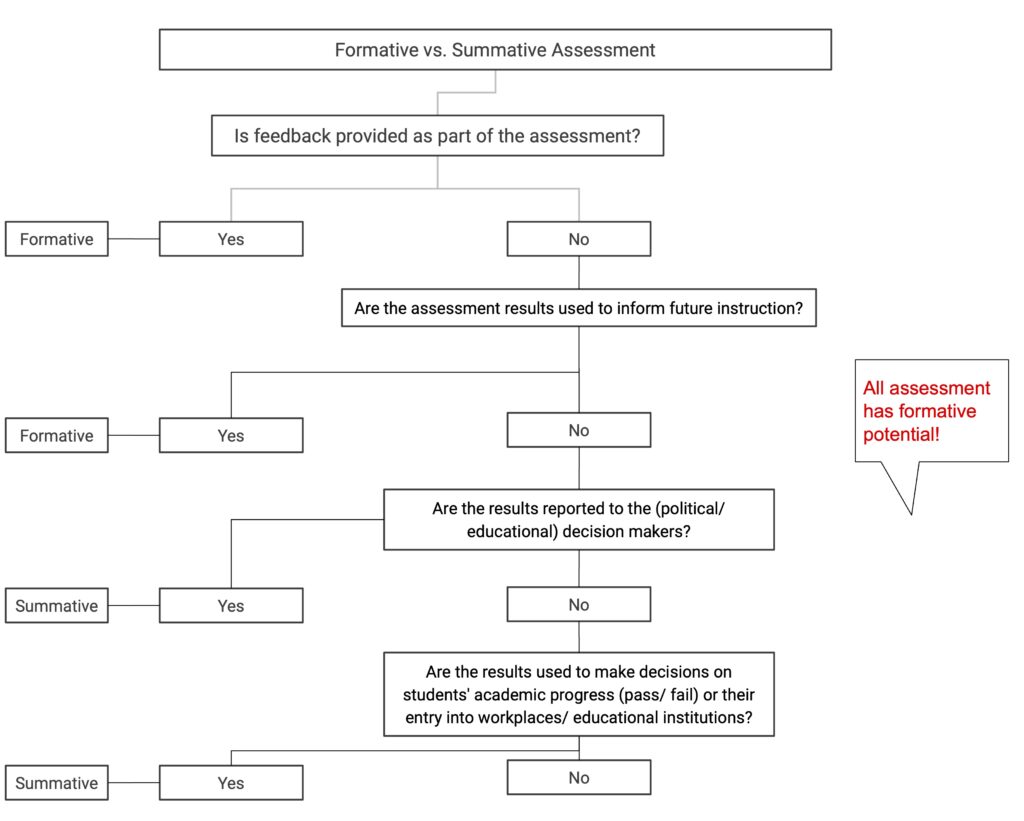
In the third stage, students should have the chance to use concepts as psychological tools. To continue with the concepts of formative vs. summative assessment above, students could be asked to review and suggest changes to assessment methods they have experienced to make them more formative. Finally, to solidify their understanding of these concepts, students should be encouraged to write reflective reports and create new SCOBAs. This allows them to compare their initial empirical concepts with their current (more developed) true concepts (Esteve Ruesca, 2018).
3. Further readings
Ruesca, O. E. (2018). Concept-based instruction in teacher education programs in Spain as illustrated by the SCOBA-mediated Barcelona formative model: Helping teachers to become transformative practitioners. In J. P. Lantolf, M. E. Poehner, & M. Swain (Eds.), The Routledge handbook of sociocultural theory and second language development (pp. 487–504). Routledge.
Ruesca (2018) offers a vivid account of how CBI was adopted in Spanish teacher education programs. This book chapter is highly recommended for those who seek example SCOBAs and clear implications for practice.
Esteve, O., Farró, L., Rodrigo, C., & Verdía, E. (2021). Meaningfully designing and implementing SCOBAs in socioculturally-based L2 teacher education programs. Language and Sociocultural Theory, 8(1), 8–34. https://doi.org/10.1558/lst.18398
This article introduces various types of SCOBAs and proposes a procedure for implementing SCOBA-based interventions. It is a great read for those who have a keen interest in SCOBAs, which are often regarded as the defining feature of CBI.
Lantolf, J. P., Xi, J., & Minakova, V. (2020). Sociocultural theory and concept-based language instruction. Language Teaching, 54(3), 327–342. https://doi.org/10.1017/S0261444820000348
This article offers a concise yet informative overview of the history of CBI with an emphasis on Galperin’s approach. The second part provides an annotated bibliography of CBI studies in language teaching and learning.
Ngo, X. M. (2024). Practical but not atheoretical: A reflection on the promise of concept-based instruction in teacher assessment literacy development. In B. Baker & L. Taylor (Eds.), Language assessment literacy and competence Volume 1: Research and reflections from the field (pp. 213–222). Cambridge University Press. https://www.cambridgeenglish.org/Images/717470-silt-volume-55.pdf
This book chapter examines both the promise and challenges of implementing CBI in assessment courses for language teachers. Although the examples concern language assessment, the proposed procedure and the key points discussed in the chapter are relevant to the adoption of CBI across disciplines.
4. References
Davydov, V. V. (1990). Types of generalization in instruction: Logical and psychological problems in the structuring of school curricula. National Council of Teachers of Mathematics.
Esteve, O., Farró, L., Rodrigo, C., & Verdía, E. (2021). Meaningfully designing and implementing SCOBAs in socioculturally-based L2 teacher education programs. Language and Sociocultural Theory, 8(1), 8–34. https://doi.org/10.1558/lst.18398
Gal’perin, P. I. (1992). Stage-by-stage formation as a method of psychological investigation. Journal of Russian & East European Psychology, 30(4), 60–80. https://doi.org/10.2753/RPO1061-0405300460
Johnson, K. E., & Golombek, P. R. (2020). Informing and transforming language teacher education pedagogy. Language Teaching Research, 24(1), 116–127. https://doi.org/10.1177/1362168818777539
Karpov, Y. V. (2018). Acquisition of scientific concepts as the content of school instruction. In J. P. Lantolf, M. E. Poehner, & M. Swain (Eds.), The Routledge handbook of sociocultural theory and second language development (pp. 102–116). Routledge.
Lantolf, J. P., Xi, J., & Minakova, V. (2020). Sociocultural theory and concept-based language instruction. Language Teaching, 54(3), 327–342. https://doi.org/10.1017/S0261444820000348
Ruesca, O. E. (2018). Concept-based instruction in teacher education programs in Spain as illustrated by the SCOBA-mediated Barcelona formative model: Helping teachers to become transformative practitioners. In J. P. Lantolf, M. E. Poehner, & M. Swain (Eds.), The Routledge handbook of sociocultural theory and second language development (pp. 487–504). Routledge.
Vygotsky, L. S. (1986). Thought and language. MIT Press.
Contributor

Views: 404
Discover more from Sociocultural theories for teaching and learning
Subscribe to get the latest posts sent to your email.