TBLT for Young Learners: Police and Thief

Introduction
Task-based language teaching (TBLT) is a pedagogical approach that arises from developments in Communicative Language Teaching (CLT) (Butler, 2011; Pemberton, 2024). This post provides practitioners with an overview of TBLT and a practical illustration of how TBLT task criteria are envisioned in a reading-to-write programme for young learners at CEFR A2 to B1 levels of English proficiency who enjoy creative and playful approaches to language learning.
A quick overview of TBLT
Cambridge dictionary defines ‘task’ as ‘a piece of work to be done’. Although there is some connection with the common definition, a task within the context of TBLT bears a specialised meaning and has the following criteria:
1. The primary focus is on meaning…
2. There should be some kind of gap (i.e. a need to convey information, to express an opinion or to infer meaning).
3. Learners should … rely on their own (linguistic and non-linguistic) resources…
4. … Language serves as the means for achieving the outcome, not as an end …
– TBLT Criteria
The definition of a task in TBLT draws heavily on the cognitive-interactionist theory (Ellis et al., 2020; Robinson, 2011). During task performance, learners utilise their linguistic resources to address challenges presented in the tasks, guided by scaffolds within input-based tasks (Robinson, 2011). Following Krashen and Mason’s (2020) Optimal Input Hypothesis, various language resources can be introduced through comprehensible input-based tasks and consciousness-raising tasks to learn target-like language forms. In TBLT, input-based tasks introduce and prime learners towards the performance of output-based tasks (Ellis et al., 2020).
Designing tasks for young learners
Research on TBLT has primarily focused on older learners and there are fewer studies conducted on young learners. In extending the criteria for creating meaningful and purposeful tasks for young learners, Pinter (2019) recommends incorporating playful elements to foster active participation, creativity and imagination when designing tasks. In addition, task design has been a pertinent issue in TBLT research due to the challenges in defining standards for sequencing tasks. In the case of young learners, I would argue that the concept of reading-to-write where reading is input for writing (Grabe and Zhang, 2016) (see the Police and Thief example below) is a potential task design approach. The reason is that young learners may have limited knowledge about the rhetorical and linguistic features of written genres. When reading and writing are taught as integrated skills, learners are guided in the processes of organising, selecting and connecting relevant input from a reading task in the production of written text (Hirvela and Belcher, 2016; Graham, 2020). This approach aligns with Krashen and Mason’s (2020) Optimal Input Hypothesis, which suggests that learners can potentially enhance their L2 proficiency through immersive exposure to the target language.
In my practice, I have utilised Renandya et al. (2020) recommendations on the reading-to-write approach along with the TBLT criteria mentioned above to develop my reading-to-write TBLT framework, which consists of three stages:
Stage 1: Reading like a reader
Learners engage in meaning-focused TBLT input-based tasks with open or closed outcomes, consisting of ‘reading comprehension’ (closed tasks) and ‘main idea comprehension’ (open tasks) to infer meaning from the text.
Stage 2: Reading like a writer
Learners are drawn to notice key rhetorical features from the Stage 1 reading tasks and output-based tasks in preparation for independent writing in Stage 3.
Stage 3: Writing like a reader
Stages 1 and 2 scaffold independent production of a written essay in Stage 3, an open task containing/leading to varied outcomes.
Although there is still a need for empirical research to validate the recommended procedure above, my extensive teaching experience of conducting TBLT writing lessons with young learners suggests that this procedure appears to work well. In the next section, I will introduce a sample series of TBLT tasks that I developed and implemented with my own students to illustrate the theoretical principles mentioned above.
My example of TBLT: Police and Thief
Police and Thief is a series of tasks to scaffold reading-to-write lessons for a group of young learners within my teaching context. The lessons are conducted with a small group of young Malaysian learners from the ages of 10 to 12 who attend after-school online English lessons at a private learning centre. The students’ language profiles are between CEFR A2 to B1.
Task 1 (Figure 1) involves both Stage 1 (Reading-like-a-reader) and Stage 2 (Reading-like-a-writer). Tasks 2 (Figures 2 and 3) and 3 (Figure 4) are independent tasks to scaffold ideas, further highlighting possible target language for story writing in Task 4 (Writing-like-a-reader). In all tasks, form-focused feedback is provided to highlight the correct forms of the target language.
The YouTube video below summarises how Police and Thief is presented through task-as-workplan. According to Ellis (2018), a workplan has low internal structure comprising a set of materials designed for task-based lessons. Unlike task-as-process, task-as-workplan specifies what will be taught without specific steps on how the lessons are taught in detail. This provides room for flexible use of the content by adapting the syllabus to the teaching context.
Figure 1.
Task 1: Introducing the background of problem-solving tasks, engaging learners with a comical crime news report


Questions 2, 3 and 4 are open tasks containing/leading to varied outcomes. Learners share the purpose for writing a crime news report before making inferences and expressing personal opinions based on the context of the events in the news. The responses may be in both oral and written form. Form-focused feedback is elicited to highlight language mistakes. These questions draw attention to the key target language features for Stage 3 (writing-like-a-reader) in Task 4, which may involve both past and present tenses/forms.
Figure 2.
Task 2: A role-playing game of identifying the thief and describing facial features

Task 2(a)
This is an information gap role-play task with closed outcomes. Students work in pairs, assuming the role of a ‘police officer’ and an ‘eyewitness’.
The eyewitness is given the information about the thief (i.e. Picture 4), but the police do not have this information. The police elicit information from the eyewitness to produce a sketch of the thief’s appearance. The eyewitness describes the thief’s appearance based on Picture 4. When the sketch is complete, the police identify which picture is described.
Figure 3.
Task 2(b)

Police and Eyewitness create a list of phrases together to describe the thief’s appearance: hair, eyebrows, eyes, nose, beard and facial hair.
The list from each pair is compared. The teacher provides feedback on the correct and incorrect phrases for describing the thief’s appearance.
Figure 4.
Task 3: A role-playing theme of police and eyewitnesses writing a report

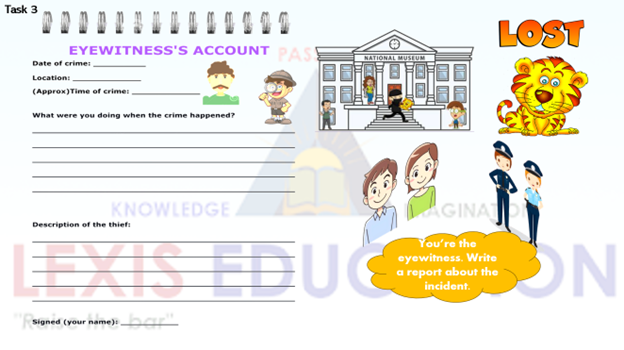
This short writing task facilitates the students’ engagement in both past and present tenses. Learners can choose between writing a Police Report or Eyewitness report, or both. Learners use their imagination to create a short story in the past tense for writing the Eyewitness report. Both reports include describing the thief’s appearance using the phrases generated in Task 2, written in the present tense.
Figure 5.
Task 4: Writing a follow-up narrative of a mysterious crime
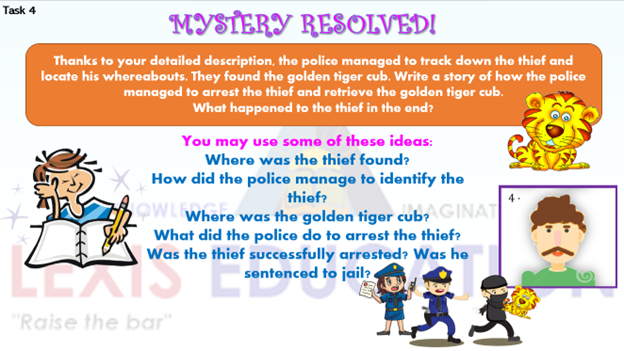
Drawing from the context in Task 1, target language and scaffolded vocabulary items from Tasks 2 and 3, learners use their imagination to write a continuation of the mysterious crime news story.
Final thoughts
From a language teacher’s perspective, TBLT has empowered me to explore creativity in lesson design beyond the paradigms of structured language teaching methods. However, this does not mean eliminating explicit language analysis, as it still plays a critical role in refining the learner’s mastery of the language.
At the initial implementation phase, some students provided feedback on how they would like the tasks to be executed. This experience exemplifies how task-as-workplan operates in a classroom setting and that the modification of tasks can be an ongoing negotiated process. I hope my reflections on Police and Thief provide helpful illustrations of the principles of TBLT tasks and how reading-to-write lessons can be created for young learners.
Recommended readings
The following key readings guided my knowledge in creating Police and Thief.
Task-based language teaching
- Ellis, R., Skehan, P., Li, S., Shintani, N., & Lambert, C. (2020). Task-based language teaching: Theory and practice. Cambridge University Press.
This textbook provides an excellent comprehensive guide on TBLT, from a practical and theoretical viewpoint.
Task-based language teaching for young learners
- Pinter, A. (2019). Agency and technology-mediated task repetition with young learners: Research and implications for primary classroom practice. Language Teaching for Young Learners, 1(2), 139-160.
This article contains a summary of structuring TBLT programmes for young learners.
References
Butler, Y. G. (2011). The implementation of communicative and task-based language teaching in the Asia-Pacific region. Annual review of applied linguistics, 31, 36-57.
Ellis, R. (2018). Reflections on task-based language teaching. Multilingual Matters.
Ellis, R., Skehan, P., Li, S., Shintani, N., & Lambert, C. (2020). Task-based language teaching: Theory and practice. Cambridge University Press.
Grabe, W., & Zhang, C. (2016). Reading-writing relationships in first and second language academic literacy development. Language Teaching, 49(3), 339-355.
Graham, S. (2020). The sciences of reading and writing must become more fully integrated. Reading Research Quarterly, 55, S35-S44.
Hirvela, A., & Belcher, D. (2016). Reading/writing and speaking/writing connections: The advantages of multimodal pedagogy. In M. P, & R. Manchon, Handbook of second and foreign language writing (pp. 587-612). Berlin: De Gruyter Mouton.
Krashen, S., & Mason, B. (2020). The optimal input hypothesis: Not all comprehensible input is of equal value. CATESOL Newsletter, 5(1), 1-2.
Pemberton, I. (2024). Communicative Language Teaching. In Usage-Based Second Language Instruction: A Context-Driven Multimedia Learning Approach (pp. 47-67). Cham: Springer Nature Switzerland.
Renandya, W., Tangkiengsirisin, S., & Floris, F. D. (2020, July 29). Bridging the reading-writing gap in second language learning. Retrieved from Willy’s ELT Corner: https://willyrenandya.com/bridging-the-reading-writing-gap-in-second-language-learning/
Robinson, P. (2011). Task‐based language learning: A review of issues. Language Learning, 61, 1-36.
Written by

Mei Yen Wong (Grace) is the founder and academic director of Lexis Education, an innovative English centre in Kuala Lumpur, Malaysia. Grace has been involved in English teaching for over a decade. In 2020, she began exploring online learning and has since been a full-time online English tutor, guiding young learners, teenagers and university students from diverse locations. Grace holds a first-class Master’s degree in TESOL from the University of Auckland, where she received the first-in-course award in computer-assisted language learning. Currently, she is pursuing her doctorate in TESOL at the University of St Andrews, UK. Her research focuses on educational psychology and conceptualising task design and implementation in task-based language teaching. Email: [email protected].
Kerry Tavakoli
Coming from a background of modern language teaching, I moved to EAP and then to teaching modules in MSc TESOL, and specialising in Second Language Acquisition theory and practice. I established the annual EAP conference in the University of St Andrews in 2010, and organised it for 13 years. At the same time, I was a member of the BALEAP executive for 6 years, giving talks at many PIMs and the BALEAP conference. I have also given papers at Inform and UKALTA. I have also taught modules on Teaching Young Learners and English Medium Instruction for many years.
Edited by

Xuan Minh Ngo is an Associate Lecturer in TESOL and International Education at the University of St Andrews, Scotland, UK. Minh’s PhD thesis on the development of teacher language assessment literacy (LAL) from a sociocultural perspective received UQ (University of Queensland, Australia) Dean’s Award for Outstanding HDR Theses in 2023 Round and DuoLingo Doctoral Research Award in 2021. His research interests lie in the intersection of language assessment, language policy, and teacher education. His works have been published in System, Language Teaching Research, English Today, Asian Englishes, Asian EFL Journal, Journal of World Languages, and recent Routledge, Springer, and Cambridge edited collections. Minh also serves on the Editorial Board of the journal of AsiaTEFL.
Post history
- Initial contribution received: 5 September 2024.
- Final version received: 21 October, 2024.
- Posted on: 26 November, 2024.
Views: 192
Discover more from Sociocultural theories for teaching and learning
Subscribe to get the latest posts sent to your email.